As soup season approaches, Campbell’s is facing a storm of controversy after two high-profile lawsuits were made public. In September 2025, the company admitted to violating the Clean Water Act over 5,000 times at its Napoleon, Ohio, plant, contaminating the Maumee river. Then, in November, a wrongful termination lawsuit from former cybersecurity analyst Robert Garza led to a leaked audio recording of Campbell’s vice president making racist remarks about employees, revealing how atrocious their quality truly is, and offensive comments against the demographic of their consumers.
According to the news publication the Detroit Free Press, on November 21st 2025 Robert Garza filed a lawsuit through the Michigan court system after he claimed Campbell wrongfully terminated his employment on January 30th 2025 for filing a complaint against the Company Vice President Martin Ballay only 20 days prior.
The complaint brought up to Garza’s Manager, J.R Aupperle, entailed that Ballay made vulgar comments about Indian employees, the poor, and the quality of their products during a meeting about salary. In the leaked recording he said, without any provocation: “[Redacted] Indians don’t know a [Redacted] thing, they couldn’t think for their [Redacted] selves.” He also claimed that their products are “[Redacted] for [Redacted] poor people.”
USA Today revealed the leaked audio that plays a crucial evidential role in this case is sourced from a television news channel: Local 4 WDIV Detroit. In the hour-long audio, the company’s Vice President states he no longer purchases Campbell’s products not only because he believes it’s only for people in poverty, but also due to quality concerns. “It’s unhealthy now that I know what the [redacted] in it…you can eat bioengineered meat” and “I don’t want to eat a [redacted] piece of chicken that came from a 3D printer.”
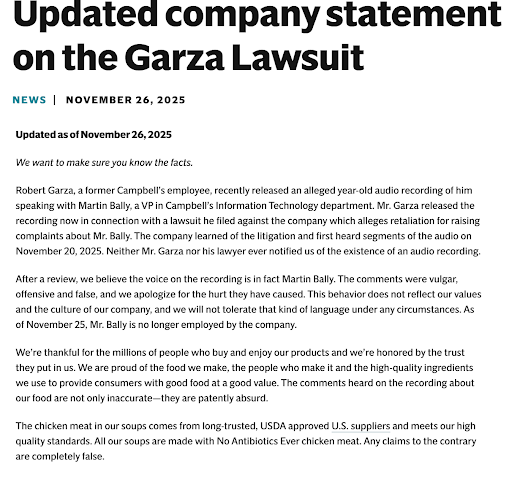
Campbell’s Soup released an official statement on their website in response to the controversy where they declared the termination of Martin Ballay, insisted that they had no knowledge of the audio, and affirmed that their products are USDA approved with high standards.
However, wrongful termination lawsuits and problematic Vice Presidents are not the only scandal the company encountered.
Back on September 15th, Campbell Soup admitted guilt to court records that were obtained by USA Today. The records disclose the company violating the Clean Water Act at their Napoleon, Ohio facility 5,468 times from April 2018 till December 2024.
The United States Environmental Protection Agency (EPA) defines the Clean Water Act as “the basic structure for regulating discharges of pollutants into the waters of the United States and regulating quality standards for surface waters,” the act prohibits the dumping of polluted materials without proper permits and limits of how much waste can be discharged with said permits, Campbell’s is guilty of not meeting either of those guidelines.
The National Environmental Law Center reported Campbell’s breach of the Clean Water Act led to E. coil, ammonia, oil, grease, and chlorine entering the Manumee River, which directly flows into the western section of Lake Erie. Campbell was not only ordered to take care of the damages, but forced to comply with environmental regulation laws after a lawsuit was filed in March of 2024.
Despite Campbell’s public apologies, placing Mark Ballay on leave, and complying with the EPA, disappointed consumers have called for a boycott against all Campbell’s products. Tiktok content creator, Dr. Jessica Knurick made a post on November 25th to spread awareness regarding the company’s scandals.
Dr. Knurick is a registered Dietitian with a PhD in nutrition who makes content regarding public health, Her post in response to Campbell’s targets more than just the quality of the products but the quality of the company. She wrote “Everyone is spiraling over the wrong part of this Campbell’s soup story…if you want to be outraged, be outraged at the system that makes racism, classism, and disregard for public health profitable.”
Her post is a reminder that Campbell’s isn’t the only company that has troublesome business practices, they are just the one who got caught: “…push for policies and regulations that make it harder for corporations to profit by cutting corners, exploiting workers, and demeaning their own customers.”